
Rumble link Bitchute link Ad-free video at my Substack
Press TV
The Knesset elections for the Israeli regime are over.
The first of its kind in three years, put off while the Zionist war machine was busy in its extermination campaign against the Gaza Strip’s civilians. With most votes counted, no candidate has secured a 61-seat majority needed to rule, and now it’s down to Benjamin Netanyahu and Gadi Eisenkot and their parties, the Likud and Yashar respectively. Charlotte Kates, international coordinator, Samidoun Palestinian Prisoner Solidarity Network, from Bierut, and Kevin Barrett, editor, Al-Andalus Tribune, from Saidia, Morocco, are tonight’s guests.
Transcript
Press TV: Hello everyone and welcome. The Knesset elections for the Israeli regime are over. First of its kind in three years, put off while the Zionist war machine was busying its extermination campaign of the Gaza Strip’s civilian population and the annihilation of its infrastructure. With most votes counted, no candidate has secured a 61-seat majority needed to govern.
And now it’s down to Benjamin Netanyahu and Gadi Eisenkot and their parties, the Likud and Yashar, respectively. The election has been marred, though, with dirt and mudslinging and allegations of sedition, incompetence and corruption between candidates, and marked by uncertainty…
Let’s delve into exactly which candidate and party supports a path toward peace with Palestinians, will work to end genocide, settlement expansion, ethnic cleansing, apartheid, occupy less, withdraw more, live and let live, and support the two-state solution. In other words, how much does the Zionist election really matter? Let’s get into it. And now for our guests.
Joining us is Charlotte Kates,, International Coordinator at the Asamidun Palestinian Prisoner Solidarity Network from Beirut. And Dr. Kevin Barrett, editor at Al-Andalus Tribune, joining us from Saidia, Morocco. Hello to both of you and welcome both of you to the program. Nice to have you both. I guess Dr. Barrett, we’ll start with you, sir. Your opening thoughts on the occupying regime’s Knesset election and how this nasty rhetoric between candidates, why they’ve gotten so nasty, and why it seems some very deep disdain, some deep divisions, are being unearthed, but ultimately it seems like nothing is really going to change.
Kevin Barrett: Well, these are really nasty people. Psychopathic leadership, which is evident in a lot of places, especially the United States recently, has always been off the charts in occupied Palestine. For whatever reason, the Zionist leadership has always consisted of gangsters. You can go back and read Thomas Suarez’s book, State of Terror, about how Zionist terror created the State of Israel. These people were thugs, criminals, mafiosi types who didn’t hesitate to slaughter not just the British and obviously the Arabs, but their own people as well. And so the descendants of these criminal terror gangs became the leadership of the Zionist entity. And that’s what we still have.
We have these two self-proclaimed Zionist parties. And what that means is that they’re two genocide parties. On the one hand, we have Netanyahu who presided over this just completely insane, brutal, bloody genocide of Gaza. And that’s just the latest of the crimes that he’s committed.
And then Eisenkot is the guy who gave us the Dahia Doctrine, which is the genocide doctrine of “disproportionate response.” In other words, if there’s any kind of attack or even a false flag attack, that’s your excuse to commit genocide and to exterminate Amalek, as their Bible tells them: Kill every man, woman, child, animal, even the pets, even the domestic animals.
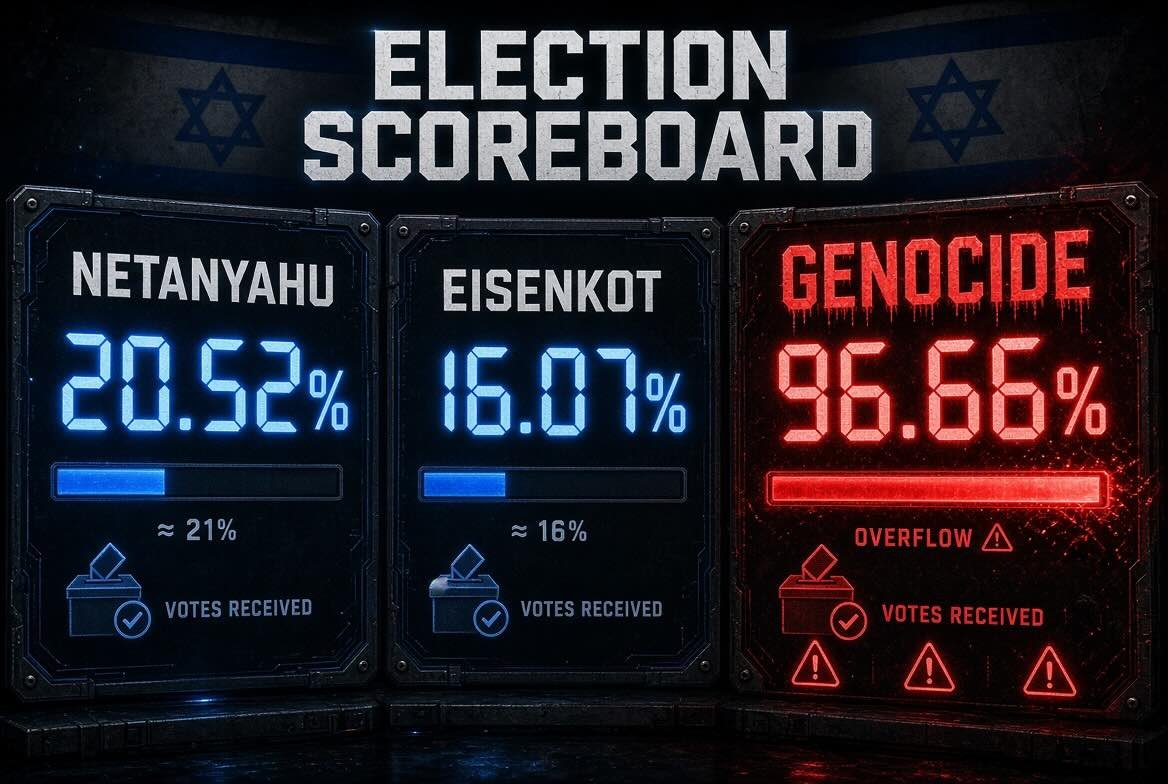
So this is a really sick society. And the vast majority of Israeli Jews voted for one or another of these pro-genocide parties. At least 95% of Israeli Jews voted for genocide.
The Arabs, many of them, didn’t, but they’re caught up in this genocide project. So the answer to that question that you posed earlier, “does this election in occupied Palestine really matter?” is: “Not in the sense that it could possibly change the evil nature of the leadership in Tel Aviv.”
But what could happen is that as a result of this outcome, where both sides are snarling at each other and insulting each other and vying for power, and both are refusing to make a majority by bringing in the Arab parties, then it’s a gridlock. And that gridlock could set the stage for civil war, or for other forms of the continued falling apart and implosion of the evil genocidal Zionist entity. And so I guess from that standpoint, it’s not the worst of outcomes. But they’re just going down and bringing the whole region with them, whatever they do, whoever’s in power.
It’s a very, very sad situation, and it’s disgusting to watch this being covered by Western media as if it’s a meaningful election in a normal democratic society.
Press TV: Thank you there, Dr. Barrett. And Charlotte Kates, welcome to the conversation. Thanks for your patience. Now, Charlotte, we mentioned the deep disdain earlier. Now, I want to just read a couple of things that Eisenkot said about Netanyahu. He called him a pathological liar, in Hebrew and English, a few times.
He blamed him for the October 7th “security failure.” He said that Netanyahu leads blindly, arrogantly, and irresponsibly, and he should have resigned long ago. He prolongs wars for political survival. He says that he will never serve under Netanyahu in a coalition.
And Netanyahu calls Eisenkot an Israeli sellout, that he’s opposed major military operations in Gaza, including into southern Gaza, the seizure of the Philadelphia Corridor in central Gaza, and expanded operations against Hezbollah. He says his policies would have left Hamas and Hezbollah more powerful. And at one point Netanyahu even said, “It’s me and Trump against Eisenkot and Abbas.”
Now, my question to you: There’s a lot of mudslinging back and forth. Guess what neither of them talk about? It’s policy. Because Eisenkot never really condemned the genocide in Gaza, the weaponization of food, fuel, and a shelter against Palestinians, right? He just picked out a couple military operations to criticize, not the overall barbarity of what’s taken place in Gaza.
Charlotte Kates: Eisenkot’s position is that the military campaign carried out by the Netanyahu government was insufficiently effective in eliminating Palestinian resistance. Gadi Eisenkot is the founder of what has been called the Dahia Doctrine: the official Zionist military doctrine of destroying and targeting civilian infrastructure, facilities, and people in order to try to sap the will of an occupied population to resist colonization and oppression.
Gadi Eisenkot was the commander of the Zionist Army’s attacks on the Great March of Return in Palestine and the sniping, the killing, and the shooting off of the legs of a whole generation of Palestinian youth in Gaza. Gadi Eisenkot and Benjamin Netanyhau are war criminals. They simply, at times, disagree on the most effective way to carry out the the genocide of Palestinians, because Eisenkot believes that Netanyahu’s tactics, and particularly the kind of showiness and the rhetorical gestures that accompany the policy of genocide, that are practiced by people like Itzmar Ben-Gvir and Bezalal Smotrich are actually inconvenient and damaging to the international reputation of the Zionist project. Gaddy Eisenkot wants to project a professional image, whereas Ben-Gvir wants to project an image of sort of thugism and paramilitaries.
The policy is the same. The mechanism of carrying it out is slightly different. But the underlying ideology, the underlying Zionist project, which is racist and genocidal in its nature, and is committed to expansion, to colonization, to the elimination by all means of as many Palestinians as possible, and to the constant expansion of the Zionist entity, they are agreed on this.
Eisenkot has been running on a platform of saying that Netanyahu has failed to eliminate Hamas, and he pledges to do it within 18 months. He is unsatisfied with the conduct of the genocide in Gaza and would like to start more of it.
Now, so you don’t really have a disagreement. You have basically a debate over the internal management of the colony, and a growing crisis about the internal management of the colony. For example, who is required to bear the burden of participating in the wars and in the genocide, who has to bear the burden of being killed by the resistance when they go and attack and invade and carry out genocide against people in Palestine, in Lebanon, in Iran, and anywhere else in the region.
I mean, Eisenkot, several of his own children were killed by the resistance as they were acting as invading and occupying forces in Gaza. And so the issue of, for example, the recruitment of the ultra-Orthodox into the army has become a huge internal domestic conflict within the Zionist entity, about how it understands itself and who bears the burden of the state ands ociety. But the fact is that the conduct of the genocide, the exclusion of Palestinians, the destruction of Palestinian life—this is simply taken for granted by all of the major parties within the Zionist system.
Press TV: And how crazy is that, Dr. Barrett, that we’re not talking about who will help secure peace and an end to the genocide in Gaza, but we’re talking about the different kinds of genocide, really like the term shades of gray, shades of genocide, which person’s approach is different and why?
Kevin Barrett: The other guest is exactly right. This is a debate really between two wings of the pro-genocide party, which is the only meaningful Zionist party. Neither one is even interested in slowing down the genocide or doing anything to lessen it. Both of them just want to do it more effectively. Netanyahu does it by showboating and bringing these crazy extremist ministers into his cabinet and doing this theatrical cruelty, sort of like Trump. And then on the other side, Eisenkot is just trying to disguise the reality with a more professional kind of demeanor. And I think the international Zionist community probably leans towards, at this point, being ready to retire Netanyahu and prefer Eisenkot. Because they’re taking a huge hit, public relations-wise, all over the world, as the world is waking up to the reality of what’s really going on in occupied Palestine, and the fact that these are complete genocidal monsters.
I mean, the whole society, basically. There are some decent Israelis, but they’re a minuscule minority. All the polls show that they can’t really be much more than about 5 percent (of Israeli Jews). The rest are psychotic, genocidal, drooling lunatics. And so that’s what their election is. It’s a circus. And these rabid freaks running both of the different sides of the circus, the different freak shows, are vying with each other and spewing vitriol at each other as they fight to see who can frame themselves as the most effective leader of the genocide. So that’s really what we’re dealing with here.
And again, the world is waking up. The younger people, especially, are waking up all over the world, and here in the United States. Actually, I’m in Morocco, but over there where I used to be in the United States, the younger people are definitely starting to notice what’s really going on. It’s becoming a major issue.
That’s why I believe the world Zionist community would have preferred an Eisenkot victory. Now they’re stuck with a deadlock. And that means maybe another election in March. Meanwhile, months of chaos. During those months, we wouldn’t be at all surprised to see the Zionist entity use its Epstein leverage over Trump to drag the Americans back into another round of war crimes in Iran and then getting their tails whipped by the Iranians militarily. And so it’s just more of the same. And anybody who thinks this election was going to actually fix anything or solve anything or change anything is out of their mind.
Press TV: Thank you there. And Charlotte, so what changes in the occupied West Bank (could happen) with the Yashar party or a new prime minister? We know that Eisenkot has criticized Netanyahu for giving authority to far-right ministers. That’s caused a lot of escalation and provocation in the occupied West Bank. We know he’s even criticized them for settler attacks.
But once he and his party get into power, what changes? When it comes to settlement expansion, daily raids on communities, detentions, homes, farms, and property demolitions and destruction, and the record settler violence that he’s criticized, does any of it change with Eisenkot in the occupied West Bank?
Charlotte Kates: Well, once again, what we’re talking about is this image of professionalism, the professional Zionist military versus the sort of thuggish settlers promoted by Ben-Gvir, Smotrich, etc. So if we think about the settlers, not just as people who are stealing the land and resources of Palestinians, but essentially as a form of paramilitary gang…Paramilitary gangs are supposed to be essentially disciplined in how they carry out their attacks on the population. And the settlers are not. They constantly require the military to come and get them out of various situations that they created. And, of course, the price is paid by Palestinians who are arrested and shot and killed by both settlers and Zionist soldiers, because settlers were engaging in deliberately provocative behavior. So it’s the opposite of professional management of the occupation. Also, Eisenkot is very concerned about the international isolation of the Zionist entity. And the settlers are the visible ugly face of Zionism. They are very openly racist in what they say. They are very openly declaring that they’re going to steal land. There is that famous quote: “If I don’t steal it, someone else is gonna steal it.”
This is something that is repulsive to the vast majority of the people of the world. And it even becomes difficult for governments like the European Union governments, which are absolutely full-on supporters and allies of the Zionist regime who, despite whatever statements they have issued, have not once stopped the flow of weaponry and diplomatic and political cover that is given to the Zionist entity, let alone the persecution of people who speak out for Palestine within Europe. Even they are not able to countenance the appearance of these settlers, the appearance of Ben-Gvir, etc.
The conditions within Zionist prisons have been awful for decades. Torture has been institutionalized in Zionist jails since the inception of the Zionist regime. But Ben-Gavir has made the torture of Palestinian prisoners in Zionist jails a centerpiece of his election campaign, and has gone into the prisons in order to promote people to vote for him.
So it’s this kind of very naked and blatant self-aggrandizing form of thuggery that doesn’t fit into the example of the kind of technologized, AI-driven, genocidal war machine that Eisenkot wants to function smoothly. Smotrich, Ben-Givir, Netanyahu, they represent the settlers paramilitaries, whereas Eisenkot comes from a military background. He represents the war establishment of the Zionist entity. So in many ways, Netanyahu and his coalition have a greater level of immediate danger because they are absolutely carrying out all forms of genocidal violence In Gaza, in the West Bank, throughout occupied Palestine, as quickly as possible. And they are very dangerous, not just to Palestine, but to all the people of the region, in Syria, in Lebanon, in Iran, in Yemen. But Eisenkot can also be more dangerous in the long term because he, in many ways, represents a more strategic approach to achieving the same goals.
Press TV: That’s wild. Do you know what that reminds me of, Dr. Barrett, when Charlotte was saying that? The Republicans and Democrats on immigration: the Democrats lambast the Republicans for demonizing immigrants and having a vast deportation policy. They get in power. What do they do? They have more deportations. They just do it more quietly and off camera than the Republicans do. But I want to ask you about…let’s take a few, a step a few kilometers outside of occupied territories. Isenkot, if he does come to power…do we see any changes in Lebanon, in Syria, with Iran?
Kevin Barrett: Well, I don’t think he’s going to come to power because he would have to bring the Arab parties into the cabinet with him. And being a rabidly genocidal Zionist, and given the tradition that these genocidal Zionist parties never ever make a coalition with the Arab parties to govern, I doubt that will happen. If it did, it would be interesting.
But still, I think that the other guest, again, is absolutely right that, ultimately, Eisenkot is probably more dangerous in terms of the Zionist entity being able to normalize its reputation enough to actually make strategic gains and hold them. It will be better able to do that if they can make a show of scapegoating Netanyahu for the excesses of the Gaza genocide while they continue to carry it out— and actually carry it out even more effectively, which is what Eisenkot has been calling for.
Right now we’re seeing the region recognizing that Israel is the problem. We’re seeing the Saudis losing to Yemen, having to run to negotiate in Iran alongside the Pakistanis and the Turks to try to come up with a regional security architecture that recognizes ultimately that the real threat to the region is the Zionist entity and its expansionism. “Greater Israel” includes parts of Saudi Arabia!
And so the region is changing, the world is changing, and Netanyahu is actually leading the charge in a way by being such a blatantly evil clown that the whole world hates. He has discredited the Zionist project, and now even these compliant puppet Western leaders of the Arab Gulf sheikdoms can no longer pretend be “normalizing.”
But if Eisenkot takes over, maybe they could. Who knows? And so that’s why, again, this election isn’t really going to change anything except for the style. But maybe the change of style will make a difference. It could be that as these two characters fight over the next few months, my prediction is that there will have to be another election in March, that that will further tarnish the Zionist entity’s image, and its cohesion—its internal cohesion. The best thing that we could hope for would be a civil war breaking out the Zionist entity that completely brings it down and liberates Palestine.
Press TV: Thank you. And Charlotte, these voters, the ones that came out and voted…how many of them do you think really want an equitable, fair, just, and internationally law-abiding governing coalition in Tel Aviv, that it matters to them, de-escalation matters to them, de-escalation of tensions with Palestinians and others in the region, really matters to them? Because it’s not evident in the vote, is it?
Charlotte Kates: When you look at the array of options that are presented, what we’ve seen time and time again is that the Zionist entity is an artificially constructed colonial society that is built on the premise of a racist ideology, which is Zionism. It’s been artificially implanted in the region on stolen Palestinian land. So it does not operate as a normal society, as a normal state, as a normal entity. It operates as a garrison that is funded and armed by Western imperialist powers, initially the British and currently primarily the United States, but also all of the other Western imperialist powers.
And so it does not function in the sense that you might think— a society debating which path it wants to follow for economic development or social change. Instead, its mission is always focused on expanding its military control and expanding its technological control over the greatest amount of land and excluding the greatest number of Arabs and Palestinians from their land. And so this nature of the Zionist entity means that the elections are essentially constantly just a series of internal crises of this project and the contradictions within the project and how they play out. But they don’t change the nature of the project itself.
Now, of course, you also have the Palestinian parties, what are called the Arab parties, which every single one of the Zionist Parties absolutely declares that they refuse to work with. But what it also reflects is that these parties actually have, despite their large voting percentages in these elections, no real power or authority. Instead, their authority is limited to choosing the Zionist in control of the Palestinian population.
Press TV: Thanks, Charlotte. And Dr. Barrett, we only have 50 seconds left. I really wanted to get your take on that exact question. What did we learn, if anything, from the Israeli voter and the way they voted in this election?
Kevin Barrett: Well, they’re still voting for genocide. And just as all the polls have shown that they were supporting the genocide of Gaza, including the deliberate murder of tens of thousands of innocent women and children, deliberately targeting noncombatants based on bogus AI algorithms, saying that there’s some Hamas person probably somewhere in the neighborhood, so let’s blow up the whole neighborhood: They’re all voting for that. They’re voting for the world’s first livestream genocide. Pretty much all of them. Maybe 95% of Israeli Jews are voting for genocide. We have to face that. We have to face the fact that this is not a normal country. It is, as Charlotte said, a genocidal settler colonial entity that’s been artificially imposed on the region as a project of theft and displacement and mass murder and again ultimately genocide, which is what we’ve been seeing in Gaza. So it’s a sad, sad spectacle to watch 95% of that population voting for this most extreme form of cruel and sadistic genocide.
But that’s what they just did.
Press TV: I’d like to thank you both and wish you both well. Thank you for being with us on the program. Charlotte Kates joining us out of Beirut and Dr. Kevin Barrett joining us out of Sadia, Morocco. This brings us to another conclusion of your Press TV Spotlight program. Thank you for tuning in and bye-bye for now.